I’m going to talk at the parallel 2016 [1]. It’s a software congress about parallel programming at Heidelberg on April 6th and 7th. Continue reading “Talks at Parallel 2016”
Author: Michael Müller
NetBeans Dream Team
I’d been invited to the NetBeans Dream Team. I am proud to be part of this team since the beginning of this year. Beside me, six other persons have become new team members. Continue reading “NetBeans Dream Team”
Neue deutsche Nationalhymne
Früher konnte eine Gruppe Studenten sowohl aus Jungs als auch aus Mädels bestehen. Doch dann kam jemand auf die Idee, “Studenten” sei ja nicht geschlechtsneutral, sondern lediglich der Plural für männliche Studenten. Das gehe natürlich nicht. Deshalb heißen Studenten heute Studierende.
Die aktuelle deutsche Nationalhymne weist gleich zwei derartige eklatante Fehler auf: “Vaterland” und “brüderlich” sind eindeutig geschlechtsdiskriminierend. Nun gibt es für Vater und Mutter den Begriff der Eltern. Also eher “Elternland”? Continue reading “Neue deutsche Nationalhymne”
NetBeans Days Germany
There are two NetBeans Days planned for Germany in 2016. Beside Munich, on March 31th, there will be a first NetBeans Day Cologne on Sept 9th.
I’m going to provide more information soon.
NetBeans and Java EE: GlassFish and Payara
When Oracle stopped the commercial support for GlassFish, there had been an exodus to WildFly and other servers. WildFly works fine with NetBeans, and I blogged how to install application servers with NetBeans [1]. Continue reading “NetBeans and Java EE: GlassFish and Payara”
DukeScript, Lambdas & Streams
Today’s applications are commonly designed for the web or mobile devices. The Java Enterprise Edition defines JavaServer Faces as UI technology. Important parts of my blog discuss this topic, for example my web development with JSF tutorial (see menu). JSF is a UI technology for the browser, like Swing is a UI technology for the desktop client.
DukeScript is a UI technology which uses HTML on top of a (minimal) virtual machine. This can be the JVM for the desktop, bck2brwsr for the browser, Dalvik for Android, or some other. As consequence, DukeScript might be used to run Java everywhere. Altogether it is an impressive technology.
Java Lambdas and Streams are brilliant features too. Introduced with Java 8, they allow you to write your code with a concise functional style.
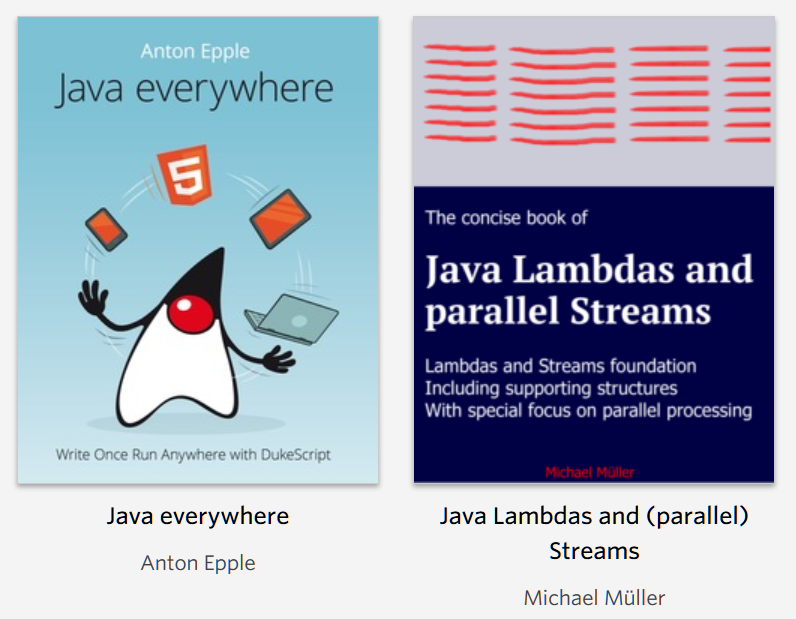
Do you like to dive deeper into these fascinating technologies? Get the books “Java everywhere” and “Java Lambdas and (parallel) Streams” bundled together for a special price [1].
Beginning NetBeans
Geertjan Wielenga (NetBeans product manager) wrote a book about the NetBeans IDE. When NetBeans 8.1 was released, my review German review about his book had been published [1]. Now, I found some time to write an English review, too. Read about it on my review site [2].
[1] heise.de/developer/artikel/Beginning-NetBeans-IDE-2878263.html
[2] it-rezension.de/Books/user/review.xhtml?bookId=225&language=en
WebSite key figures
Since beginning of 2012, I track visits of my web site to generate some anonymous statistics. This is done by using Piwik on my local server. To keep your privacy, only shortened IP addresses are recorded by this tracking system.
I’m going to present some key-figures, which might be interesting to know about. My blog is almost about computer science, especially web development. Developers may prefer other systems and devices than users with different interests. Thus, these key-figures cannot be generalized. They only represent data about visitors of my blog. Continue reading “WebSite key figures”
NetBeans and Java EE: Localized Bean Validation
Bean Validation is part of the Java EE 7 specification. Some usage is described in my book Web Development with Java and JSF, [1] and a full description of the Bean Validation is available at [2].
Bean Validation might be used for validation in JSF too. Behind the scenes, there is a lot to do: JSF must discover whether Bean Validation is used and invoke it if needed. The essence of this invocation is shown in a short code snippet which demonstrates the principle. Continue reading “NetBeans and Java EE: Localized Bean Validation”
2. Kölner IT-Security-Konferenz
Am 26. November 2015 fand in Köln die zweite “Kölner IT-Security-Konferenz” statt.
Veranstaltet von der GFU Cyrus AG kamen nach Angaben des Veranstalters mit rund 120 Teilnehmern rund 50% mehr als zur ersten Auflage. Wenn auch noch ein überschaubarer Rahmen zeigt dies doch das steigende Bewustsein für IT-Sicherheit auf. Continue reading “2. Kölner IT-Security-Konferenz”